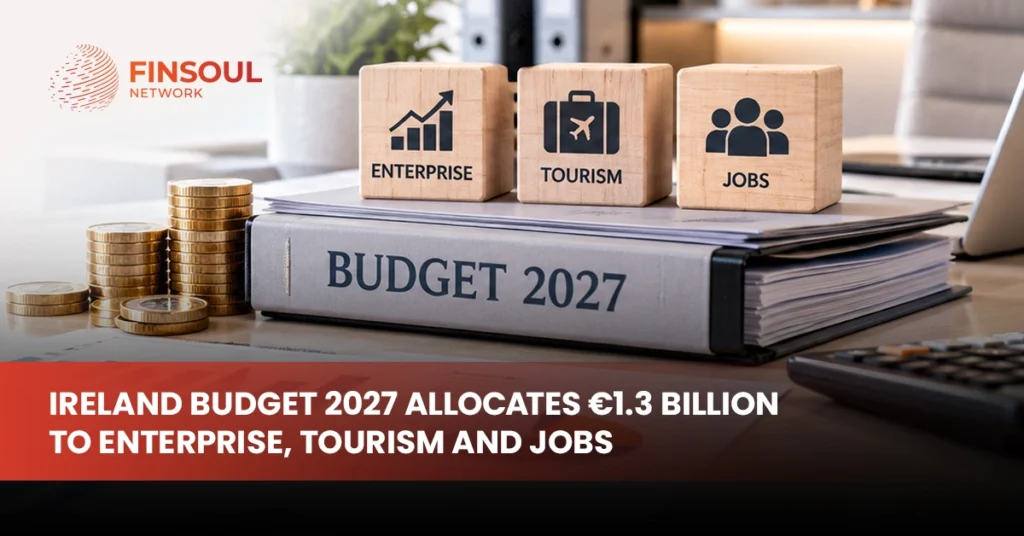
Ireland’s Budget 2027 includes €1.3485 billion for enterprise, tourism and employment, with funding aimed at business growth, innovation, job creation and regional development. Announced by the Department of Enterprise, Tourism and Employment on 7 October 2026, the allocation combines €638.5 million in current expenditure with €710 million in capital funding.
For Irish companies, entrepreneurs and overseas investors, the announcements are relevant to decisions about financing, recruitment, research and development, and expansion. Finsoul Ireland can be a point of contact for businesses assessing their establishment and compliance needs as they consider these opportunities. The practical question is how the funding translates into support for businesses and workers and which announcements deserve attention first.
What Does the Ireland Budget 2027 Mean for Businesses?
The allocation covers enterprise development, tourism, employment, digital technology and research. It also includes specific funding for start-ups, small and medium-sized enterprises (SMEs), AI development and regional investment. The department’s funding is divided into two main categories:
- Current expenditure: €638.5 million for ongoing programmes and departmental activities.
- Capital funding: €710 million for investment and development.
Together, these allocations total €1.3485 billion. They represent the budget for this department, rather than the entire Irish national budget. For businesses, the value of these measures will depend on eligibility, application requirements and implementation dates. An announced funding allocation does not automatically mean every company can claim a grant or loan. Businesses should check the conditions of individual schemes before including potential support in their financial plans.
Funding for Start-ups and Small Businesses
One of the main announcements is €3 million to establish Start Up Ireland, an initiative intended to support 1,000 new start-ups. It is designed to give founders a central route to funding, expertise and business support as they develop their companies.
The budget also includes €4.5 million in additional funding for Local Enterprise Offices, including support for small businesses investing in energy efficiency. These offices are an important starting point for eligible local businesses seeking advice, training and financial support.
For an early-stage company, these measures may be relevant when preparing a business plan, estimating operating costs or deciding whether to recruit. However, the €3 million allocation is funding for the initiative, not a guaranteed payment to each start-up.
A €500 million loan scheme for business growth
The government has announced a €500 million expansion of the Growth and Sustainability Loan Scheme. Eligible businesses may access long-term finance of up to €500,000 on an unsecured basis, subject to the scheme’s terms and lender assessment. The expansion is being delivered in partnership with the European Investment Bank Group.
Companies considering this route should prepare realistic cash-flow forecasts, assess their ability to repay borrowing and identify how the proposed investment will support business performance. A loan can fund expansion, but it also creates a repayment obligation.
Investment in AI, Research, and Technology
Technology investment is another major part of the budget. Additional funding includes €7.5 million for Technology Centres and €6.5 million for the Disruptive Technologies Innovation Fund. These programmes support industry-led research, collaboration and the development of new technologies.
The National AI Office of Ireland will receive €2.3 million in additional funding, bringing its total budget to €3.8 million. The allocation will support implementation of the EU AI Act, development of an AI regulatory sandbox and national AI literacy.
For companies developing software, industrial technology or AI-based products, these announcements indicate continued public investment in research and technology adoption. Businesses should check the specific eligibility rules of each programme before committing expenditure in anticipation of support.
Research-intensive companies should also review the relevant tax provisions and technical conditions before claiming research and development relief. Budget announcements alone do not establish that every development activity qualifies.
Employment Costs and Tax Changes
The employment measures matter to companies planning recruitment and reviewing payroll budgets. The National Minimum Wage is set to rise by €0.79 to €14.94 an hour for workers aged 20 and over. The higher-rate Employer PRSI threshold will also increase from €552 to €600 per week for 2027. These changes affect different parts of an employer’s cost base. A higher minimum wage increases pay for affected workers, while the revised PRSI threshold changes the point at which the higher employer contribution rate applies.
Businesses should review employment contracts, payroll settings and staffing forecasts before the relevant changes take effect. Employers with part-time and lower-paid staff should assess the impact on total wage costs rather than considering hourly pay in isolation.
Other announced measures include a reduction in Capital Gains Tax from 33% to 31%. This may be relevant to entrepreneurs and investors considering the disposal of qualifying assets, although the tax treatment depends on the transaction and the applicable rules. Companies should seek appropriate tax advice before making a sale, restructuring ownership or changing their investment plans. A headline rate does not determine the final liability in every case.
Tourism and Regional Business Development
Tourism remains a focus of public investment, particularly in regional destinations. The budget allocates an additional €6.65 million to Fáilte Ireland for tourism product and destination development. Tourism Ireland will receive an additional €2.5 million for international marketing, including promotion in new and high-growth markets.
These allocations are intended to support visitor demand and tourism-related economic activity. Their effects may extend to accommodation providers, attractions, restaurants, transport operators and local suppliers, although individual businesses will not automatically receive funding.
Tourism businesses can use the announcements as a reason to review their capacity, seasonal staffing, marketing plans and investment priorities. Those considering grant assistance should consult the relevant tourism agency for current programmes and application conditions.
Regional businesses may also benefit indirectly if destination development attracts more visitors and encourages spending across local supply chains. Actual results will depend on visitor demand, operating costs and the delivery of funded projects.
What Should Businesses Do Next?
The Ireland Budget 2027 announcements give businesses several areas to review, but preparation is essential before applying for support or changing financial plans.
Companies should take four practical steps:
- Review funding eligibility. Check the National Enterprise Hub, Local Enterprise Offices and relevant agencies for scheme conditions, application windows and required documents.
- Update financial forecasts. Include expected wage changes, employer contributions, borrowing costs and planned capital expenditure.
- Assess investment plans. Identify whether spending on research, energy efficiency, digital systems or tourism development fits an available programme.
- Check tax and compliance obligations. Confirm the rules that apply to the business before relying on a tax relief or making changes to its structure.
For businesses entering Ireland or expanding their operations, the Ireland Budget 2027 measures should be considered alongside company registration, tax registration, payroll and ongoing reporting obligations. Finsoul Ireland can be approached for business advisory and compliance support relevant to these requirements.
The Ireland Budget 2027 package creates opportunities for eligible companies, but funding should be treated as a potential source of support rather than guaranteed income. The Budget 2027 measures will be most useful to businesses that understand the conditions, plan expenditure carefully and act on confirmed opportunities.
Conclusion
Ireland’s latest enterprise budget focuses on start-ups, business finance, technology, employment and tourism. For companies, the next step is to identify which measures apply to their plans and prepare the financial and compliance information needed to act on them. Finsoul Ireland supports businesses reviewing their establishment and compliance requirements as they plan for growth in Ireland.
Address: Office Suite, The Courtyard, Fairhill, Killarney, Co. Kerry, V93 N8XN, Ireland
Contact No: +353851722576
Email: info@finsoulireland.com
Frequently Asked Questions
How much funding is allocated to enterprise, tourism and employment?
The department has received €1.3485 billion for 2027, comprising €638.5 million in current expenditure and €710 million in capital funding.
Can start-ups apply for funding under the new budget?
The €3 million Start Up Ireland initiative is intended to support 1,000 new start-ups. Founders should check the official programme details for eligibility and application arrangements as they become available.
Does every Irish business qualify for government support?
No. Each grant, loan or tax incentive has its own conditions. Businesses must check the relevant scheme rules and meet the applicable requirements before relying on assistance.
Where can businesses find official information?
The Department of Enterprise, Tourism and Employment’s Budget 2027 announcement and the National Enterprise Hub’s Budget 2027 guidance are useful starting points.