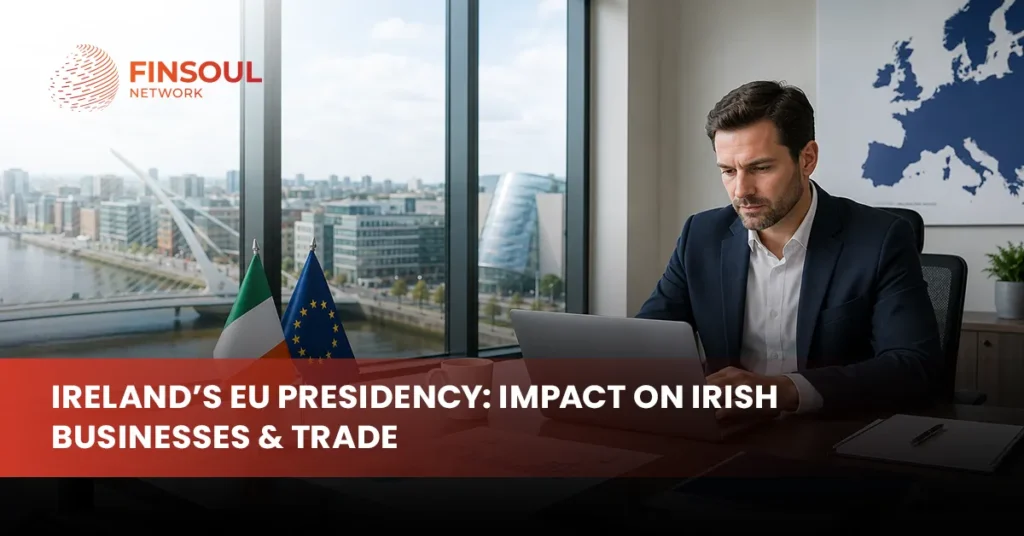
Ireland EU Presidency began on 1 July 2026 and will continue until 31 December 2026, giving Ireland the responsibility of chairing meetings of the Council of the European Union, helping Member States reach agreement and progressing EU legislative and policy discussions. For Irish businesses, this period creates an opportunity to influence discussions around competitiveness, the Single Market, investment, digital transformation, innovation and trade.
Finsoul Ireland helps businesses understand changes in the European business environment and assess how regulatory, economic and trade developments may affect their operations. While the Presidency does not directly change Irish business law, the policies and legislative files advanced during this period can influence the conditions in which companies operate across Ireland and the wider EU.
What Does Ireland’s EU Presidency Mean for Irish Businesses?
The Council Presidency rotates between EU Member States every six months. During its term, Ireland chairs Council meetings, facilitates negotiations between Member States and works to build consensus on legislative and policy matters. Ireland is holding the Presidency for the eighth time, following Cyprus and preceding Lithuania.
For businesses, the significance lies in the issues Ireland chooses to prioritise and the progress it helps achieve on EU proposals. Companies may see longer-term effects from measures concerning the Single Market, competitiveness, digital transformation, industrial policy, investment and regulatory simplification. The Presidency does not give Ireland unilateral authority to introduce EU laws. Final legislation still follows the EU’s established decision-making process involving the Council, European Parliament and European Commission.
What Are Ireland’s Main EU Presidency Priorities?
Ireland’s programme places strong emphasis on creating a more competitive, innovative and resilient European economy. The Government has identified investment, simplification, business growth, sustainable and digital transitions and open, rules-based trade as important themes. Key priorities include:
- Strengthening European competitiveness
- Improving the functioning of the Single Market
- Reducing unnecessary regulatory burdens
- Supporting SMEs and scaling businesses
- Encouraging investment and innovation
- Advancing digital and AI transformation
- Supporting sustainable industrial development
- Strengthening economic resilience and supply chains
- Promoting quality employment and skills
- Supporting open, rules-based international trade
These priorities are particularly relevant to Irish companies that trade across EU borders or depend on European supply chains.
How Could the Presidency Affect Irish Businesses?
Ireland’s EU Presidency could affect businesses mainly through the EU policy and legislative agenda that Ireland helps progress during its six-month term. The practical impact will depend on which proposals reach agreement and how subsequent legislation is implemented. The Department of Enterprise, Tourism and Employment has identified several priority legislative files, including EU Inc, the Industrial Accelerator Act, Chips Act 2.0, the European Product Act and the European Competitiveness Fund. For Irish businesses, developments in these areas could influence:
- Company formation and expansion
- Access to EU markets
- Regulatory compliance
- Investment opportunities
- Digital infrastructure
- Manufacturing competitiveness
- Innovation and technology adoption
- Cross-border trade
- Supply-chain resilience
Businesses should therefore monitor developments rather than assume that every Presidency priority will immediately create a new legal obligation.
How Could the Single Market Benefit Irish Companies?
The Single Market is one of the most commercially important areas of the Presidency for Irish companies. Ireland has identified the removal of barriers to cross-border trade in goods and services as a major priority. In May 2026, the Government announced a new Single Market Taskforce, Single Market Office and Advisory Panel to help identify and address barriers affecting businesses. The initiative aims to reduce regulatory fragmentation and make it easier for Irish companies to trade and scale across Europe. Improved Single Market functioning could benefit companies by making it easier to:
- Sell products in other EU countries
- Provide services across borders
- Expand into new markets
- Build European supply chains
- Recruit and operate across Member States
- Scale business operations
For SMEs in particular, reducing administrative complexity could make cross-border expansion more practical.
What Does the Presidency Mean for Irish Trade?
Ireland’s presidency places trade within a broader agenda of competitiveness and open, rules-based economic relations. The government has stated that promoting open trade and strengthening Ireland’s international economic relationships remain important elements of its wider economic policy.
The Presidency can provide Ireland with greater visibility when EU member states discuss trade-related priorities. However, businesses should distinguish between Ireland’s role as Council President and the EU’s wider authority over common commercial policy.
A trade agreement negotiated at EU level can create opportunities for Irish exporters by improving market access, reducing certain barriers and establishing common rules. The actual effect depends on the specific agreement, sector and implementation requirements.
How Could Trade Agreements Affect Irish Businesses?
A trade agreement can influence the costs and conditions associated with international trade. Depending on its provisions, it may address tariffs, customs procedures, market access, regulatory cooperation, intellectual property or public procurement. For Irish businesses, the potential effects include:
- New export opportunities
- Improved access to international markets
- Changes in import costs
- New compliance requirements
- Greater competition from overseas businesses
- Opportunities to diversify supply chains
Businesses should assess each agreement based on their products, markets and supply-chain structure rather than assuming that every agreement will have the same commercial impact.
What Role Does Foreign Affairs and Trade Play?
Ireland’s trade policy involves cooperation across Government, with the Department of Foreign Affairs playing an important role in Ireland’s international relations and external economic engagement. The Government’s market diversification work also identifies EU Presidency opportunities to advance the Single Market and support Irish-based companies.
The broader trade agenda includes strengthening relationships with international partners, supporting exporters and maintaining Ireland’s commitment to open and rules-based trade. For businesses, this means international market opportunities should be assessed alongside EU policy developments, bilateral relationships and changes in global trading conditions.
How Could SMEs Benefit From Ireland’s EU Presidency?
Small and medium-sized businesses are a clear focus of Ireland’s Presidency agenda. The Government has highlighted reducing administrative burdens and improving the business environment for SMEs as cross-cutting priorities. Potential benefits include simpler regulatory processes, better access to the Single Market, improved opportunities to scale and greater support for innovation.
However, these benefits will depend on the final outcome of EU negotiations and subsequent implementation. SMEs should continue reviewing their own compliance and operating processes rather than waiting for regulatory changes to take effect.
How Could EU Digital Policies Affect Irish Companies?
Digital transformation is another major Presidency priority. Ireland intends to progress discussions on areas including AI, cloud infrastructure and digital competitiveness.
A major Presidency event will be the International AI Summit in Dublin in October 2026, which is intended to bring together government, industry and academic leaders to examine how applied AI can support productivity, competitiveness and innovation. Irish companies should consider how developments in AI, cloud computing, cybersecurity and digital regulation could affect their technology investments and compliance responsibilities.
Which Industries Would Be Most Affected?
The impact will vary between sectors because different industries are subject to different EU rules and market conditions.
Technology and AI
Technology businesses may benefit from discussions around AI, cloud infrastructure, digital transformation and European technology competitiveness.
Manufacturing
Manufacturers may be affected by developments in industrial policy, supply-chain resilience, product regulation and access to components.
Life Sciences
Ireland’s significant life sciences sector may monitor developments affecting innovation, regulation, investment and European market access.
Financial and Professional Services
Professional and financial services businesses should track developments affecting the Single Market, digital services and cross-border operations.
Tourism and Hospitality
The Presidency also includes work on sustainable tourism, digital transformation and the competitiveness of Europe’s tourism sector.
Start-ups and High-Growth Companies
Proposals such as EU Inc could become particularly relevant to companies seeking to establish and scale operations across multiple EU Member States.
What Is EU Inc and Why Could It Matter?
EU Inc, also referred to as the proposed 28th Regime, aims to create a more streamlined company-law framework for innovative companies operating across the Single Market. Ireland has identified EU Inc as one of the priority legislative files for its Presidency. The proposal is intended to make it easier for innovative businesses to establish, scale and operate across EU markets. If the initiative progresses, businesses should monitor the final legal framework and assess whether the new structure could simplify expansion or corporate administration.
How Could Regulatory Simplification Help Businesses?
Regulatory simplification is a major part of Ireland’s 2026 agenda. The objective is not simply to remove rules but to make EU requirements more proportionate, effective and easier for businesses to understand and comply with. This is particularly important for SMEs that may not have large internal compliance teams.
Simplification could help companies reduce administrative time, improve internal processes and focus more resources on commercial activities. The actual benefit will depend on the measures adopted and how they are implemented across Member States.
What Challenges Could Irish Businesses Face?
The presidency may create opportunities, but businesses should also prepare for potential challenges. These can include:
- New EU regulatory requirements
- Changes to existing compliance processes
- Increased competition across the Single Market
- Higher expectations around digital adoption
- Supply-chain adjustments
- New product or sustainability requirements
- Uncertainty while legislation is being negotiated
- Additional reporting obligations
Companies should avoid making major decisions based solely on proposed measures. Businesses should wait for confirmed legislation and implementation guidance before changing critical compliance procedures.
How Should Irish Businesses Prepare in 2026?
Businesses can take several practical steps to stay prepared during the Presidency.
Monitor EU Policy Developments
Follow confirmed developments from the Irish Government, European Commission and other relevant EU institutions.
Review Regulatory Exposure
Identify which EU regulations and legislative proposals directly affect your sector, products or services.
Assess Cross-Border Opportunities
Businesses that currently operate only in Ireland should review whether improved Single Market access could support expansion into other EU markets.
Strengthen Digital Capabilities
Companies should assess their use of AI, cloud services, data systems and other digital technologies as European digital policy develops.
Review Supply Chains
Manufacturers and importers should monitor changes affecting customs, tariffs, sourcing and strategic supply chains.
Seek Professional Advice
Businesses facing complex regulatory or cross-border issues should obtain professional advice before making significant commercial or compliance decisions.
Could Ireland’s Presidency Improve Ireland’s Business Environment?
The potential is significant, particularly if Ireland succeeds in progressing measures that reduce barriers, strengthen competitiveness and improve Single Market access. The Government’s 2026 programme specifically focuses on investment, simplification, innovation, business growth and economic resilience. It also aims to advance measures that could support strategic industries and improve conditions for businesses operating throughout Europe.
However, businesses should view these as policy objectives rather than guaranteed commercial outcomes. EU legislation normally requires negotiation and agreement between the relevant institutions and Member States.
What Should Businesses Watch Until December 2026?
The Ireland EU Presidency runs until 31 December 2026. During this period, businesses should monitor progress on the legislative files most relevant to their sector. Important areas to follow include:
- Single Market reforms
- EU Inc
- Industrial policy
- European Competitiveness Fund
- AI and digital legislation
- Product regulation
- Space policy
- Sustainable tourism
- Employment and skills
- Trade and international economic relations
Ireland’s Department of Enterprise, Tourism and Employment is also hosting Council meetings, stakeholder forums and other Presidency events throughout the term.
What Happens When Ireland’s EU Presidency Ends?
Ireland will hand the rotating presidency to Lithuania on 1 January 2027. The end of the presidency does not mean that all initiatives discussed during the six-month period will end.
Legislative proposals may continue through the EU decision-making process after Ireland’s term. Companies should therefore track important files beyond December 2026, particularly where proposed legislation could affect their sector.
Conclusion
Ireland’s EU Presidency gives the country an important role in shaping discussions on competitiveness, single market reform, investment, innovation, digital transformation and open trade during the second half of 2026. For Irish businesses, the most relevant developments will be those that affect market access, regulatory requirements, investment, technology and cross-border operations.
Companies should monitor confirmed policy developments, review their regulatory exposure and identify opportunities arising from a stronger and more integrated Single Market. The Presidency does not guarantee immediate changes for individual businesses, but it provides Ireland with an important opportunity to influence the direction of EU economic policy.
Finsoul Ireland can help businesses assess regulatory, commercial and strategic developments that may affect their operations in Ireland and across European markets. A structured review can help management teams understand emerging requirements, identify business opportunities and prepare for changes arising from EU policy developments.
Frequently Asked Questions
When is Ireland’s EU Presidency in 2026?
Ireland holds the rotating Presidency of the Council of the European Union from 1 July to 31 December 2026.
How does the EU Presidency affect Irish businesses?
The Presidency allows Ireland to chair Council meetings, facilitate negotiations and help progress EU legislation and policy. Its business impact depends on the outcomes of those negotiations and subsequent implementation.
Will Ireland’s EU Presidency change Irish business regulations?
Not automatically. The Presidency itself does not directly create new Irish regulations. However, EU legislation progressed during the term may later create obligations or opportunities for Irish businesses.
What is EU Inc?
EU Inc is a proposed 28th Regime intended to provide a more streamlined company-law framework for innovative businesses operating across the EU Single Market.
What is the role of the President of the EU Council?
The President of the European Council chairs meetings of EU heads of state or government, helps build consensus between Member States and represents the EU at the highest political level on common foreign and security policy matters.